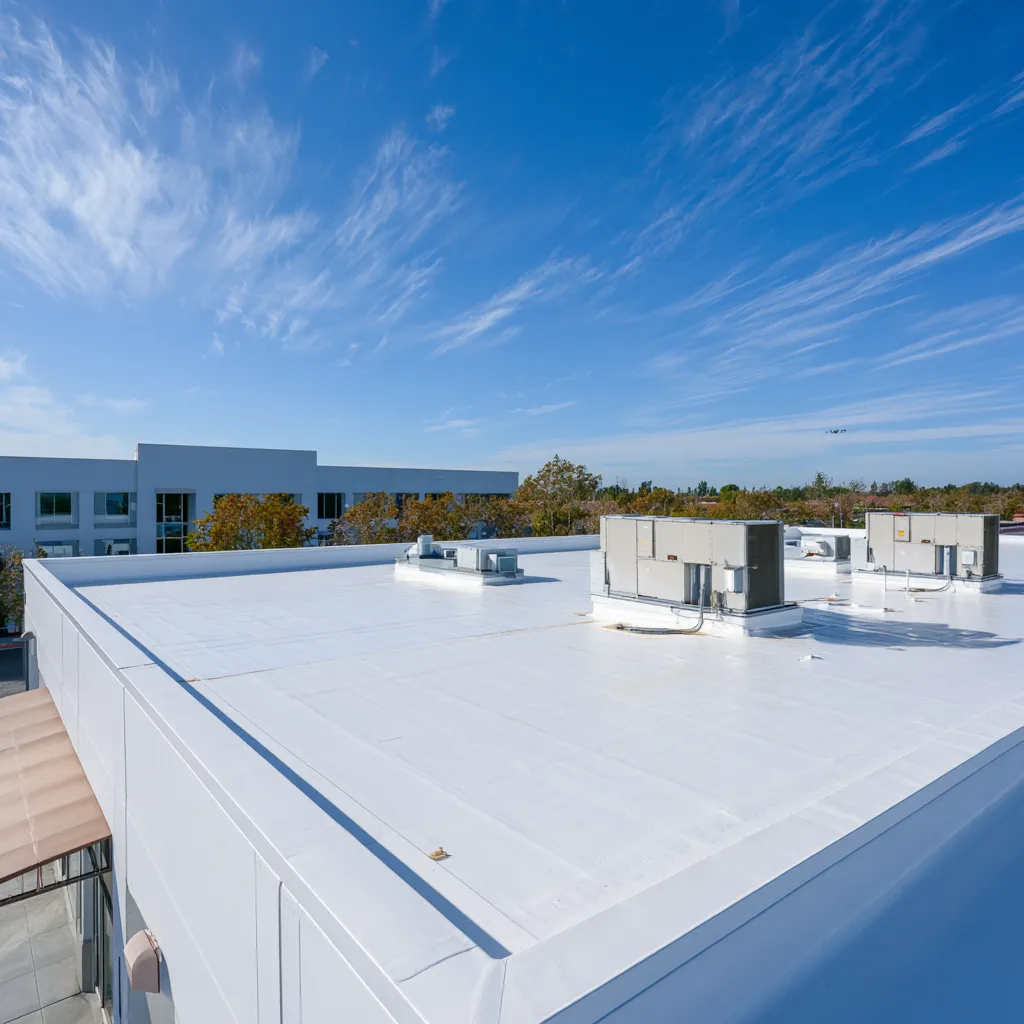
Every aging flat roof in McKinney eventually puts its owner at the same fork: coat what is there, put a new membrane over it, or tear the whole assembly off and start again. The price gaps between those paths are large, the sales pitches for each are loud, and the right answer is usually determined by something none of the pitches mention: whether the insulation under the membrane is wet. Here is how the decision actually runs.
Start with the moisture test, not the brochure
Everything hinges on what is under the surface. A roof whose insulation is dry and whose deck is sound has all three options open. A roof with saturated insulation has only one real option, because covering wet material, with coating or with new membrane, seals the water in and buys a failure with extra steps.
So a legitimate commercial evaluation starts with moisture: core samples or scanning, plus a walk of the seams, flashings, and drains. Ten minutes of testing routinely redirects tens of thousands of dollars, in either direction.
Path one: coat and restore
On a dry, structurally sound roof, a fluid-applied coating, silicone for roofs that pond water, acrylic for roofs that drain clean, reseals the surface and adds a warrantied decade or more. Industry pricing typically lands well below replacement, often by half or better, which is why restoration is the budget-bridge move for owners who need years, not a new asset.
The discipline is in the prep: failed seams and flashings get repaired first, then the coating goes on at the thickness its warranty requires. A coating quoted without a moisture test and prep scope is a red flag wearing a low price.
Path two: recover with a new membrane
Code generally allows one recover: a new membrane, commonly TPO, installed over the existing roof when the old assembly is dry and the building is not already carrying two roofs. It skips tear-off cost and disruption while delivering a truly new surface with a full manufacturer warranty program.
The same moisture gate applies, and so does a structural one: the deck has to carry the added assembly. When those pass, a TPO recover is often the best value on the board for a mid-hold owner.
Path three: tear off and rebuild
Wet insulation, a deteriorating deck, or a roof already at two layers ends the debate: the old assembly comes off. It is the most expensive path and the only honest one for a failed roof, and it resets everything, insulation, slope package, drainage, warranty, for the longest run of trouble-free years.
Owners rarely enjoy hearing it, which is why the recommendation should arrive with the evidence attached: core photos, moisture readings, and a scope an owner can hand to a board or lender without translation.
Match the choice to your hold horizon
The building's future matters as much as its roof. An owner selling within a few years rarely gets their money back from a tear-off; a documented restoration may serve the sale better. An owner holding for decades is usually buying the tear-off eventually, and paying twice to delay it is the expensive kind of thrift.
That is the whole decision: test first, price every path that passes, and weigh them against how long the building stays yours. A documented commercial survey puts all three numbers on one page.